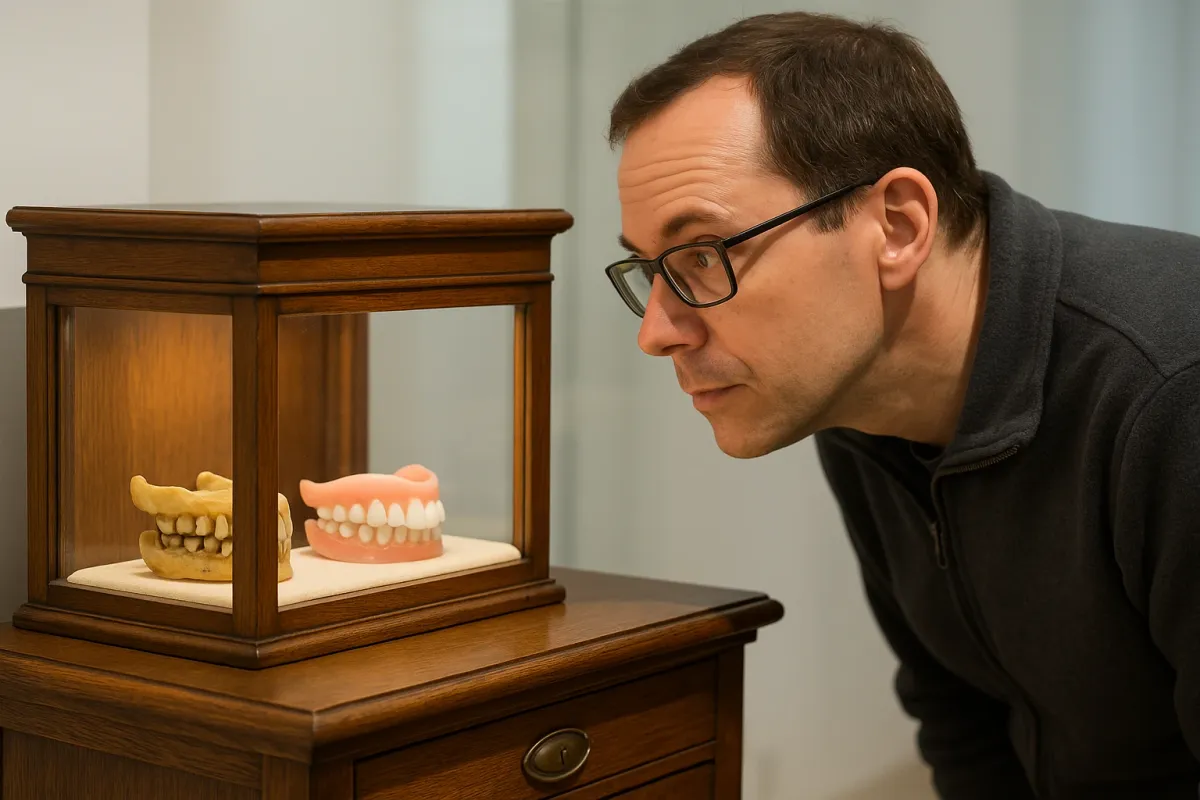
Every few months, the internet rediscovers a past it no longer recognizes. The latest viral fascination—those “40 Obsolete Things” circulating through social media—has done more than stir nostalgia. It has quietly reminded us how swiftly once‑standard objects become relics: cassette tapes, rotary phones, film cameras, even early laptops. What was cutting‑edge yesterday now feels quaint today.
Denture technology is undergoing the same transformation, only far more personally. Just as few of us would willingly return to dial‑up internet, an increasing number of discerning patients are discovering they no longer need to tolerate “old‑fashioned” dentures—thick, unstable, and visibly artificial. In a world where yesterday’s gadgets are museum pieces, it’s worth asking: which denture types are already functionally obsolete, and which represent the new standard of refined, long‑term comfort?
Drawing inspiration from the way that viral “obsolete things” article has people reassessing what they keep—and what they quietly upgrade—this guide explores how modern denture types are evolving right now. Below are five exclusive, detail‑driven insights to help you choose a solution that will feel sophisticated, not outdated, in the decade ahead.
1. Traditional Acrylic Full Dentures Are the “Rotary Phones” of Prosthetics
Conventional acrylic full dentures—pink plastic base, acrylic teeth, held in place mainly by suction and adhesive—are the healthcare equivalent of a rotary phone: they still work, but they no longer reflect what is possible.
Many patients accept looseness, sore spots, and speech difficulties because that is what their parents or grandparents experienced. In clinical reality, these older styles persist largely because they are inexpensive and familiar, not because they are optimal. Their core limitations are structural: acrylic bases must be relatively thick for strength, which can feel bulky; they sit entirely on top of the gums, so the slightest bone resorption beneath them leads to rocking and slipping; and long‑term wear can accelerate further bone loss.
The “obsolete items” conversation online is a useful mental model here. The question is no longer, “Does it work?” but “Is this still the best way to achieve the result?” For many sophisticated patients, the answer with fully conventional dentures is increasingly “no”—especially when compared with more modern, anchored, or hybrid options that offer better stability and a slimmer, more natural feel.
2. Implant‑Retained Dentures Are the Discreet Upgrade Nobody Sees—But You Always Feel
Where old‑style dentures rely on gums and adhesives, implant‑retained dentures rely on something far more elegant: your own jawbone. A small number of titanium implants—often four in the lower jaw and, in some cases, four to six in the upper—act like artificial roots. The denture then “snaps” or locks onto precision attachments, transforming a once‑wobbly prosthesis into a secure, confident bite.
This shift mirrors the move from clunky desktop computers to sleek ultraportables: the function is similar, but the experience is utterly different. Patients often describe three quiet luxuries:
- Predictable stability in social settings – Speaking, laughing, and dining without the subconscious fear of a sudden slip.
- Freedom from heavy adhesive use – A cleaner, more streamlined morning and evening routine.
- Improved chewing efficiency – Particularly with tougher textures like crusty bread or lean meats, which many people had quietly eliminated from their diets.
Modern dental implant systems from established companies—think Straumann, Nobel Biocare, Dentsply Sirona, and others—have refined components that allow ultra‑precise fits and interchangeable attachment designs. For individuals seeking a premium yet discreet enhancement, implant‑retained overdentures often represent the point where traditional dentures begin to feel truly “outdated.”
3. Fixed “All‑on‑X” Hybrids Are the Flagship Model—But They Are Not for Everyone
In the same way that design‑forward smartphones and ultrabooks replaced entire categories of older tech, full‑arch, fixed implant solutions (often marketed as “All‑on‑4,” “All‑on‑6,” or broadly “All‑on‑X”) have redefined what is possible when replacing a full set of teeth. These prosthetics are anchored permanently to implants and are not meant to be removed at home. Functionally, they behave more like natural teeth than like traditional dentures.
However, the online conversation around premium dentistry sometimes glosses over nuance. The sophisticated reality:
- They require impeccable planning and collaboration. High‑end results typically come from interdisciplinary teams—surgical specialists, restorative dentists, and advanced dental labs using CAD/CAM technology and digital smile design.
- Maintenance remains essential. While they do not come out daily, fixed prostheses need professional cleanings beneath them at set intervals, often using special instruments or water‑based hygiene systems.
- They are an investment in both time and resources. The upfront cost, surgical commitment, and healing period are substantial. For some, this is a considered, worthwhile investment; for others, a high‑quality implant‑retained removable solution is more proportionate and flexible.
The takeaway: fixed full‑arch options are the flagship category in modern denture‑type restorations, but a truly premium plan respects lifestyle, health status, and long‑term adaptability—not just the allure of the “top‑shelf” label.
4. High‑End Partial Dentures Are Quietly Replacing the Visible Metal “Framework Look”
Among denture types, partials are undergoing one of the most elegant evolutions. Traditional metal‑framework partial dentures—with visible clasps hugging front teeth—are beginning to feel as dated as visible antennae on early mobile phones. They are sturdy and functional, but in polished social or professional environments, many patients find the metallic flashes distracting.
Two newer directions are worth noting:
- Precision‑attachment partials – Instead of visible clasps, these use hidden, engineered connectors such as intra‑coronal attachments or milled crowns with internal housings. To others, your remaining teeth simply appear whole; the connection points are concealed within the prosthesis. This design requires more planning and restoration of the anchor teeth but delivers a far more seamless aesthetic.
- Advanced flexible materials, used selectively – Premium flexible partials, when designed judiciously (not as an all‑purpose solution), can provide nearly invisible gum‑colored clasps that blend gracefully with surrounding tissues. They are especially suited to transitional or aesthetic‑priority situations, such as replacing a few front teeth during an implant healing phase.
In the context of that viral “obsolete things” conversation, think of basic clasp‑heavy partials as the visible wires and bulky adapters of yesterday’s devices. The emerging standard emphasizes integration: fewer obvious components, more natural continuity.
5. Digital Denture Design Is Making “One‑Size‑Fits‑Most” Fit a Thing of the Past
One subtle thread in people’s fascination with obsolete objects is precision. We marvel at how far we have come—from grainy analog displays to pin‑sharp screens, from clacking keyboards to silent, ultra‑responsive interfaces. The same evolution is happening, almost quietly, in the realm of denture design.
Digital dentures—created with intraoral scanning or high‑accuracy impressions, CAD/CAM software, and milled or 3D‑printed materials—offer refinements that older analog processes simply could not match:
- Repeatable precision – Your digital file can be stored, refined, and re‑used, making adjustments and remakes more predictable and less intrusive.
- Subtle personalization – Tooth shape, arrangement, and even micro‑texture can be tailored to echo your natural dentition or curated aesthetic preferences—whether understated, youthful, or timelessly classic.
- Material sophistication – High‑impact resins, multi‑layered acrylics, and hybrid materials allow slimmer designs without sacrificing strength. This often translates into a lighter, less intrusive feel and improved speech clarity.
- Faster refinement loops – Instead of multiple rounds of trial wax dentures, digital workflows can move from design to try‑in more efficiently, particularly when paired with photorealistic smile previews.
For patients who value detail—the feel of a finely balanced pen, the sound of a well‑tuned car door closing—digital dentures provide that same sense of deliberate craftsmanship. They mark the departure from “standard plates” toward bespoke oral prosthetics that belong in the modern world, not in the gallery of quaint artifacts.
Conclusion
The renewed cultural fascination with “obsolete things” is more than a nostalgic pastime; it is a subtle invitation to reassess what we still tolerate simply because we are used to it. In dental prosthetics, that means recognizing that thick, unstable, or visibly artificial dentures are no longer the inevitable price of tooth loss.
Today’s denture types range from elegantly engineered implant‑retained overdentures to digitally crafted partials with invisible precision attachments. The most refined choice is not always the most extreme or expensive option, but the one that aligns your comfort, function, aesthetics, and long‑term health with the best that current technology offers.
In an era where yesterday’s marvels can become tomorrow’s curiosities overnight, your smile deserves to belong firmly to the present—and to age gracefully into the future, never feeling like an artifact of the past.
Key Takeaway
The most important thing to remember from this article is that this information can change how you think about Denture Types.